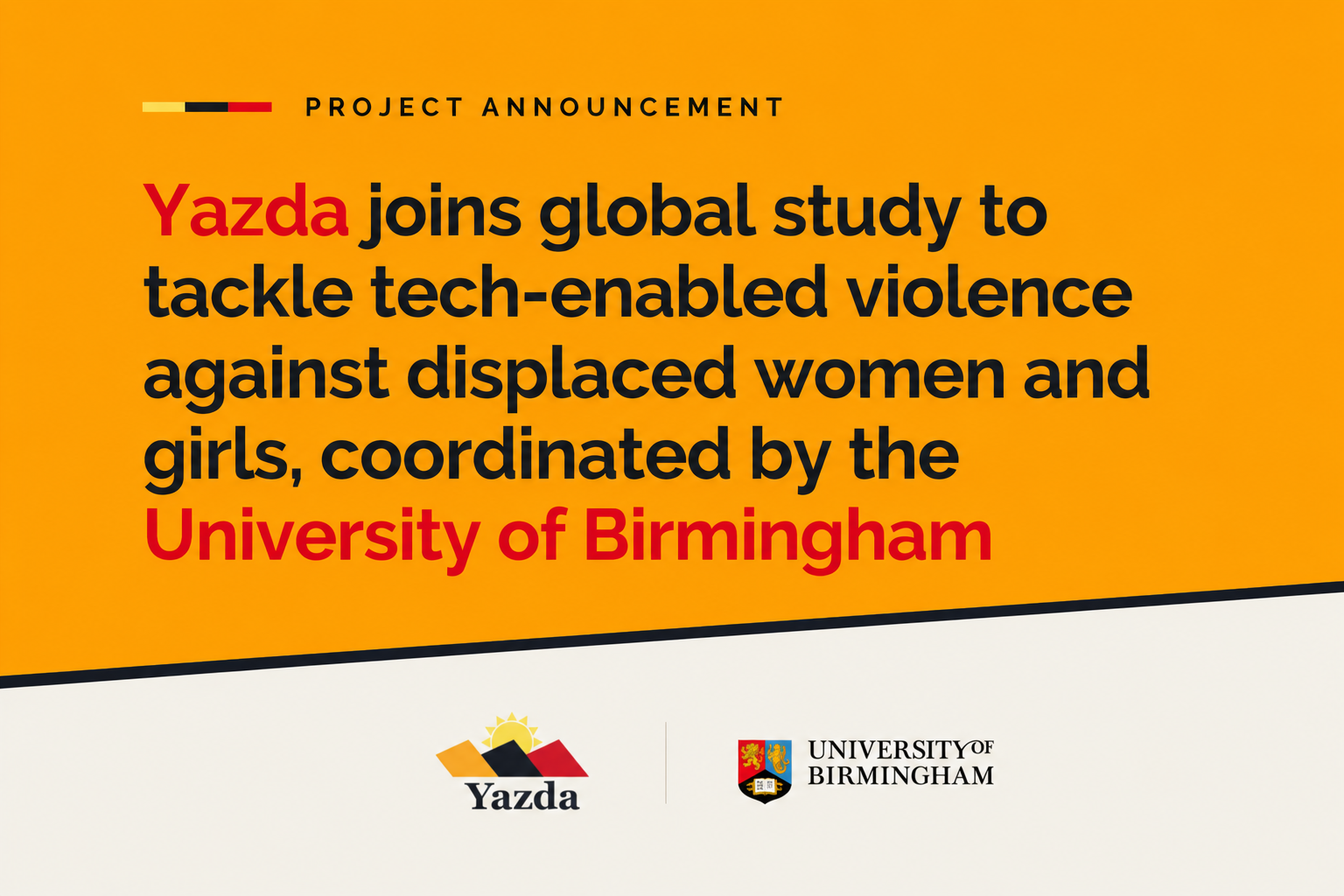
Yazda Joins Global Study to Tackle Tech-Enabled Violence Against Displaced Women and Girls
Duhok, Iraq, 8 July 2026
Yazda has joined TRACE, a new three-year research project coordinated by the University of Birmingham to build the first evidence base on how technology-facilitated gender-based violence is experienced by people living through conflict, displacement and refuge. Funded by the European Union's Horizon Europe programme , the project runs from October 2026 to September 2029 and brings together fifteen partners across eight countries, including universities, legal practitioners, humanitarian actors and survivor-led organisations such as Yazda in Iraq.
Technology-facilitated gender-based violence refers to acts of gender-based violence committed, assisted or aggravated through digital technologies. For displaced people, technology can be both a lifeline and a source of danger. TRACE will examine how perpetrators weaponise digital tools to target, harm and control displaced populations, and develop methods to prevent, recognise and respond to that abuse.
Natia Navrouzov, Executive Director of Yazda, said: "The genocide against the Yazidis demonstrated that technology can be weaponized to facilitate atrocity crimes. ISIL used digital platforms to spread propaganda, recruit perpetrators, advertise and sell Yazidi women and girls into sexual slavery, and terrorise entire communities. Today, survivors continue to face online harassment, intimidation and the circulation of images and content that retraumatise them, showing that these harms do not end when conflict ends. TRACE is an important step towards understanding how technology-facilitated violence operates across the conflict, displacement and recovery journey, so that governments, justice institutions and technology companies can better protect survivors and prevent these abuses from being repeated."
Professor Heather Flowe, who leads TRACE at the University of Birmingham, added: "Displaced women and girls are among the most exposed to digital abuse, and among the least protected by the systems meant to keep them safe. This project will give policymakers, courts and platforms the evidence they need to recognise this violence for what it is and to act on it."
The research combines AI-enabled pattern recognition, survivor-centred qualitative research and legal analysis across multiple conflict, transit and refuge settings. It is structured around two measures: a conflict–displacement–refuge continuum that traces digital harms across time and space, and an online–offline continuum that captures how virtual and physical violence intersect.
The findings are expected to inform implementation of the Istanbul Convention and the EU Directive on combating violence against women and domestic violence, producing early-warning typologies, survivor guidance and recommendations for governments, courts and technology platforms.
The consortium comprises fifteen partners:
University of Birmingham (UK, coordinator)
University of Sheffield (UK)
University College London (UK)
Stop the Traffik (UK)
Western University (Canada)
Başkent University (Türkiye)
Support to Life Association / Hayata Destek (Türkiye)
International Nuremberg Principles Academy (Germany)
University of Leipzig (Germany)
Uppsala University (Sweden)
National University of Kyiv-Mohyla Academy (Ukraine)
Taras Shevchenko National University of Kyiv (Ukraine)
Truth Hounds (Ukraine)
Women's Initiatives for Gender Justice (Netherlands)
Yazda (Iraq)
###
Download this press release here
Read this Press Release in Arabic here
For media inquiries, please contact:
For media inquiries about the wider TRACE project or Professor Heather Flowe, please contact:
Tim Mayo, Press Office, University of Birmingham | t.mayo@bham.ac.uk | +44 (0)7815 607 157
Notes to editors:
TRACE (Grant Agreement No 101287413) is a Horizon Europe Research and Innovation Action funded under the call HORIZON-CL2-2025-01, topic HORIZON-CL2-2025-01-TRANSFO-01, "Tackling gender-based violence in different social and economic spheres." It is coordinated by the University of Birmingham and runs from 1 October 2026 to 30 September 2029.
Funded by the European Union. Views and opinions expressed are however those of the author(s) only and do not necessarily reflect those of the European Union or the European Research Executive Agency (REA). Neither the European Union nor the granting authority can be held responsible for them.
About Yazda:
Yazda is a non-governmental, non-profit organization that was established in 2014 in response to the genocide committed by the self-declared Islamic State (ISIS) against the Yazidis and other minorities in Iraq. Yazda manages a portfolio of humanitarian, justice, advocacy, and development-related projects, all of which are community and survivor-centered in terms of design and implementation. Since its inception, Yazda has been working with local and international partners to provide humanitarian, accountability, and advocacy services to vulnerable minority groups in Iraq in their post-genocide recovery. The organization has been operating in Iraq since October 2014 and has main offices in Duhok in the Kurdistan Region of Iraq and a branch office in Sinjar in Nineveh Province. Yazda is registered as a non-profit organization in the United States, the United Kingdom, Iraq, Kurdistan Region of Iraq. Over the past 8 years, Yazda has grown to employ around 80 staff on average, received support from numerous donors, both institutional and individual, and has reached tens of thousands of direct and indirect beneficiaries through its programs and initiatives.